
(Disney Meets Darwin)
2 The Art of Motion
Animation, when viewed as an art form, is more about motion-based expression and communication of certain ideas and feelings than on accurate simulation of physics or animal behavior, which has been a major focus of most research in this area. In general, animators have a story to tell, and it is usually not totally reliant on physical realism or efficiency of motion within spacetime constraints. The tradition of classical character animation reminds us that physics and biological realism are routinely violated for the purposes of character personality and narration. Systems which incorporate genetic algorithms for evolution of behavior in articulated figures solve the physical problems of optimizing behavior, but do not afford the optimization of expressivity. Optimization of expressivity cannot easily be accomplished with straightforward fitness functions.
My explorations are based on the assumption that it requires some feedback with a human in the optimizing loop. Animation systems would benefit from tools which support expressive communication between the animator and the animated, as things evolve, while simultaneously keeping behaviors within objectively defined constraints.
An articulated figure which demonstrates evolved locomotion behavior may not exhibit much of a style or personality, when optimized without an animator's guidance. Figure 1 illustrates this notion that the inclusion of an animator's interactive evaluation during the optimizing loop can encourage styles of behavior. The idea is suggested here by contrasting an automatically-evolved locomotion behavior (top row) with a behavior in which an animator has encouraged a "style" (bottom row). This affected walk may not exhibit optimal minimization of energy in the gait, but it may be funnier or more expressive.
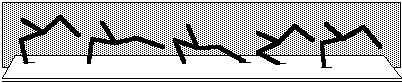
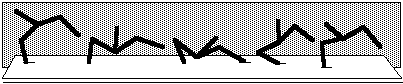
Figure 1. Illustration of the effect of encouraging a "style" of a locomotion behavior during evolution.
3 Background
