
(Disney Meets Darwin)
8 Evolution

A population of genotypes are evolved Darwin-style, using a succession of generations, with the more successful genotypes in each generation having more offspring than the less successful ones, for the next generation. This system is comparable to the interactive evolution systems developed by Dawkins [86] and Sims [91], and others, which use a human observer as the fitness function. An important difference in the current work is the emphasis on evaluation of real-time motion qualities.
An interactive evolution system works basically like this: a population of phenotypes is displayed - as in Figure 5, on the next page. A user can select favorable individuals from the population, assign fitness rewards or penalties, and affect reproduction of individuals' genotypes, resulting in new populations of phenotypes.
There are a number of reproduction styles which have been used, including asexual reproduction (one parent per generation, with mutation), or sexual reproduction (each individual in the population is the result of two parents mating through crossover). These actions are done a number of times, and the attributes of the phenotypes gradually (sometimes very quickly) take on qualities the user is seeking.
My system uses a variety of reproductive styles and adjustable controls for things like mutation rate and population size. It also has controls for randomizing the genotypes of a population, selecting among different species, saving and loading genotype files, tweaking individual genes of one individual, and initiating automatic evolution.
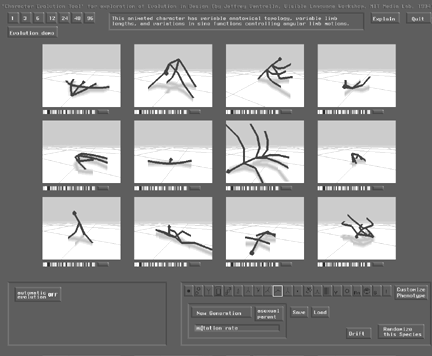
Figure 5. The interface
9 The Biological Clock
