
Appendix C
The Physics Model for the Articulated Figures
The model is simple yet produces many of the salient features of interacting objects in the real world, such as gravitational effects, inertia, angular and translational momentum, friction, and dampening. An articulated figure is treated essentially as a rigid body which can deform itself internally but cannot be deformed passively by way of outside forces such as collision with the ground surface. So, for instance, when the figure collides with the ground surface, the angles of its joints are not affected. Only the overall angular velocity and translational velocity are affected.
Collision with the Ground Surface
The only environmental agent that affects the figure is the ground, with which the figure has frequent contact due to gravity. Most of the computation happens here, each time a part of the body encounters the ground. Translational and angular velocities of the figure change - with the nature of the change depending on where the collision is in relation to the figure's center of mass, and the velocity of the point of contact upon collision. The four basic functions of this model are explained in non-mathematical terms, with low-tech illustrations. I will describe these collision functions for the 3D figures, since the 2D figure world can be seen as basically a subset of the 3D world.
1) vertical translational velocity
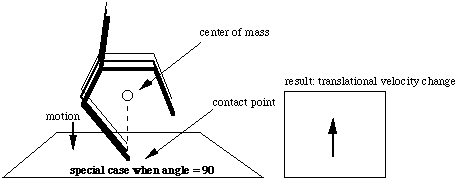
Upward motion of the figure is caused when the collision point lies under the center of mass. This is basically the equivalent of a bounce. The degree (an angle quantity) of which the point lies under the center of mass determines the degree in which downward velocity of the contact point is transferred to upward velocity in the whole figure. A dampening constant affects the amount of energy absorbed by the ground and figure, thus lessening the bounce effect. Figure C.1 illustrates this function.
2) angular velocity on the XZ and YZ (vertical) planes
Downward collision with the ground causes angular velocity changes when the contact point is NOT directly below the center of mass. The degree in which the contact point is below the center of mass (an angle value) determines the degree in which the downward motion at the point of contact is converted into upward velocity in the whole figure (as illustrated in collision function 1). When this angle value is exactly 0 degrees or 180 degrees (limit cases), the vertical movement of the contact point is converted entirely into angular velocity in the vertical planes. Usually, the angular relation of the contact point to the center of mass is neither 0, 90, or 180; thus some combination of translational and angular velocity results. Figure C.2 illustrates this function.
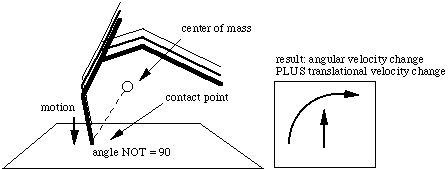
Figure C.2 Upon collision with the ground, downward motion in the collision point is converted into a combination of upward velocity and angular velocity for the whole figure, when the contact point is NOT directly below the figure's center of mass.
3) horizontal translational velocity
Due to friction, any horizontal motion of the collision point causes a degree of opposite motion in the whole figure. Here the horizontal movement in the collision point affects the amount of reaction forceÑwhen the XY components of the movement is parallel to an XY line connecting the contact point with the center of mass. Figure C.3 illustrates this function.
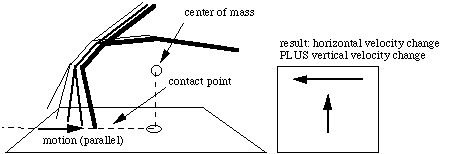
Figure C.3 Upon collision with the ground, any degree of horizontal motion in the collision point is converted into an opposite horizontal push for the whole figure, when movement point is parallel to an XY line connecting the collision point to the XY center of mass.
4) angular velocity on the XY (ground) plane
Angular momentum in the XY plane (around the Z, or vertical axis) is changed when horizontal movement in the contact point is perpendicular to a line connecting the contact point with the center of mass, thus describing an angular change about the center of mass. Figure C.4 illustrates this function.
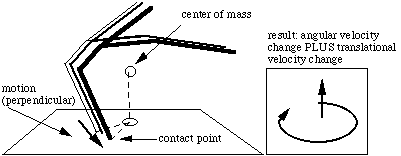
Figure C.4 Upon collision with the ground, horizontal motion in the collision point is converted into angular velocity about the vertical axis, when the motion is perpendicular to an XY line connecting the collision point to the XY center of mass.
In all of these cases, the amount of downward movement in the collision point (how much force there is in the collision) determines the amount of kinetic energy which is converted to angular or translational velocity.
References
