
(Disney Meets Darwin)
1: Introduction

In this thesis I describe a computer animation tool I have developed and the reasons behind its development. It is called the Character Evolution Tool. It serves both as a prototype tool for animators and designers, and as a testbed for the applicability of evolutionary algorithms in computer animation. The work is built on an assumption that not just animated characters but all kinds of graphical entities can have a "body language." It also assumes that this body language is something that can evolve over time to become progressively more effective in expressing something, and having a style of moving about. These qualities are still not easily achieved in most computer-based character animation systems - yet they are abundant in classic cel animated cartoons.
To imbue characters with personality, humor, and style is a goal for many animators. This research can be described as an ongoing quest which began while I was exploring simple physically based human-like figures for animation. I wanted my figures to be able to move on their own, using internal forces, as a starting point for higher levels of control. This basic motivation has been the impetus for a number of other systems developed (Badler et al., 91). For enhancing humorous and stylistic qualities in my figures, I found that I required an added level to the techniques developed thus far: a highly interactive interface allowing enhanced communication between the animator and the animated.
Genetic algorithms (Holland, 75) have been used recently for evolving goal-directed behavior in physically based, articulated figures (Ngo and Marks, 93). (Refer ahead to 'Background Research' for a quick definition of genetic algorithms). This work has successfully shown that genetic algorithms are effective in optimizing their motions for locomotion and other objectively defined goals. But it has not, however, focused on a means to imbue the figures with expressive characteristics and stylistic variations by way of a designer's interactive contribution to the evolutionary process. I have proposed to address the problem of designing humor and body language in animated characters with an hypothesis: expressivity, not just objectively-defined behaviors, can be the product of progressive refinement. I have attempted to test this by combining the automatic optimizing capabilities of a genetic algorithms with direct interactive tools, and allowing a blending of automated and user-guided evolution. This system can be seen then as extending the standard genetic algorithm in that it adds multiple levels of interactivity to the automatic process, to achieve higher levels of control. This interactivity is manifest on two basic levels:
1) interactively guiding evolution
2) gesturing to demonstrate motion
Expressivity Through Guided Evolution
In this system, the means for deriving expressive behavior in these characters is biologically inspired. It uses an evolutionary algorithm which allows identifiable behavioral qualities in animated graphics to emerge over time. The term, 'expressive' as used here is defined as the ability of a graphical object, through MOTION, to evoke information, ideas, or feelings, for the sake of communication, humor, or aesthetics. As a first glimpse of the varieties of "characters" one can evolve with this system, Figure 1 illustrates three varieties (swarms, blinkers, and articulated figures).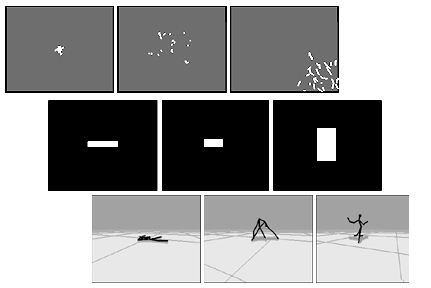
Figure 1 Three stages of evolution for three of the classes of characters available
in this system: swarms, blinkers, and articulated figures.
This illustration shows three stages of each character's evolution towards more expressive, and otherwise useful, forms and motions. The swarms become more life-like, the blinkers become more effective attention-grabbers and acquire optimal blinking rates (in this illustration, only shape and size can be shown), and the articulated figures exhibit locomotion or humorous dance-like movements.
The graphical objects I have focused on in this research are animal-like articulated stick figures with autonomous motion, but the concepts and techniques from this class of graphical objects have been carried over to a larger class of graphical objects which can exhibit behavior (they can change states over time). This includes graphical interface widgets, and other object-oriented graphical agents which can have behavior. They are called, in this thesis, "behavior objects." In Figure 2, the generic concept of a "character" is illustrated, as being any behavior object which can exhibit dynamic behavior for purposes of expressivity.
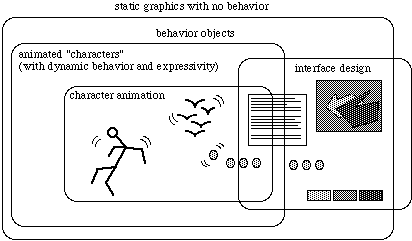
Figure 2 The general concept of a "character" as defined in the
Character Evolution Tool - a graphical object with expressive dynamic behavior.
Thus the class of objects known as animated characters can be expanded to include all graphical objects which can exhibit motion behavior. In this thesis, I sometimes reference this general notion of character, in order to place my work in the larger context of communication graphics. Primarily I will focus on the articulated figures, and a set of tools for directing this class of behavior objects, as the focus of this research.
Computer Animation Not Alive Enough
Physically based animated characters whose behaviors adapt through the use of a genetic algorithm have been shown to demonstrate realistic behaviors such as locomotion. But they are often devoid of the expressive content which makes traditional hand-drawn characters so effective in comparison. In these systems, the science of the design of animated characters is not yet useful for the art.Animation, seen as an art, should be concerned more with motion-based expression and communication of certain ideas and feelings than on mere simulation of physics or animal behavior, which has been a major focus of most research in this area. In general, animators have a story to tell, and it is usually not totally reliant on physical realism or efficiency of motion within spacetime constraints. The Disney tradition of character animation reminds us that physics and biological realism are routinely violated for the purposes of character personality and narration. Systems which incorporate genetic algorithm's for evolution of behavior in articulated figures solve the physical problems of optimizing behavior, but do not afford the optimization of expressivity, above and beyond the constraints from evolutionary fitness pressures. Optimization of expressivity cannot easily be accomplished with straightforward fitness functions. This thesis assumes that it requires some feedback with a human in the optimizing loop. Animation systems would benefit from tools which support expressive communication between the animator and the animated, as things evolve, while simultaneously keeping behaviors within objectively defined constraints.
"Move Like This" - Survival of the Fittest
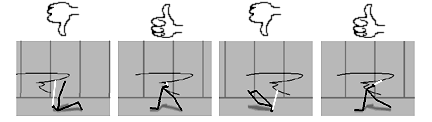
An experimental method for interactively demonstrating motion by gesturing into the scene has been implemented in the Character Evolution Tool. It will be discussed as a potential new contribution to character animation research. Since this system is based on an evolutionary paradigm, the gesture tool essentially allows a free form line which is drawn into the scene to become a form of evolutionary pressure which drives a character's motions to assume attributes of the gesture. Two gesture matching algorithms have been implemented which compare the input gesture with the character's motions. Figure 3 offers a cartoon explanation of the concept behind the gesture tool.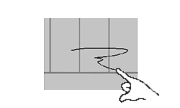
Evolution and Design
Underlying this research is the idea that Darwinian Evolution and Design, often considered antithetical processes, can be brought together into one coherent system. We often refer to Design as a top-down organizational process, involving decision and planning, and we consider Evolution to be a bottom-up, distributed process, involving chance. But creative design (as viewed in this thesis) generally involves a certain amount of bottom-up organization and chance. The idea in this thesis is that computational evolution can augment the design process for this reason. Genetic algorithms are good at searching for optimal solutions in arbitrarily large multiparameter spaces. Design can also be said to be an activity of searching a large problem space for solutions. Both make use of experimentation, both make use of iterative evaluation. These kinds of notions are much more thoroughly explored by Hybs and Gero (92).In creative design, especially in the earlier stages of the design process, designers are not always completely aware of what they are making or how to go about doing it. Serendipity often plays a role in the process, and one generally improves the working design iteratively. In short, the act of designing itself is an evolutionary process. Considering genetic algorithms as serendipity enhancers (chance mutations can beget successful strategies), we can see how a process based on evolution can be merged with a design tool - if the interface is carefully constructed to support this. I have attempted to develop an interface which brings these processes together, within the context of animated graphics.
BACKGROUND AND RELATED WORK
