
(Disney Meets Darwin)
3: Approach
In the Disney tradition, animation is the illusion of life (Thomas, 81). Character animation research has added to this the simulation of life. Animals are complex things which, according to Darwinism, have become the complex things that they are because of evolution. Artificial life researchers take this approach when modeling artificial organisms, in studying emergent self-organizing phenomena. As indicated by the background research I have outlined, the evolutionary techniques which are central to artificial life research have also begun to influence character animation research. I have taken this approach, with an added emphasis on the creation of funny characters with personality, by way of interactive techniques. One might infer from the title of this thesis that the Character Evolution Tool is based on "survival of the cutest." But it is aimed at being more than just this - the qualities that one can extract from a population can have a great range of body language.
Two Levels of Evolution
In this thesis, I consider expressivity to be the product of progressive refinement, which requires that a human be in the GA loop. Figure 6. illustrates a behavior in which the user has affected the course of automatic evolution via an overlay of interactive evolution.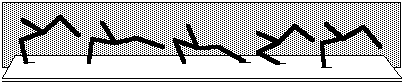
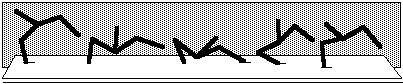
Figure 6 The top panel illustrates a walking pattern which emerged in a population under fitness pressures for locomotion and holding the head high. This character's behaviors have been automatically optimized through these fitness pressures. The bottom panel shows a character from the same population in which a user affected the direction of evolution by favoring ancestors who walked with a desirable style.
In the top panel of the illustration, a walking pattern is shown which emerged in a population evolved under fitness pressures for locomotion and holding the head high. This character is optimized according to these fitness functions. The bottom panel shows a character from the same population in which the user has affected the direction of evolution by favoring ancestors who walked with a particular style. This is accomplished by combining the automatic optimizing capabilities of a GA with interactive tools, and allowing a blending of automated and user-guided evolution. And perhaps most importantly, the proportion of user-guided vs. automated evolution can vary.
This can be seen as the overall approach: a system which blends automatically-driven evolution with the critical vision of an interacting human. Essentially, the source of evolution at any given time may not be entirely distinguishable to the user - for instance, if an active objective fitness function is encouraging locomotion, through the GA, the user may also be encouraging behaviors that make the locomotion look like swaggering, or skipping, or shuffling. "Shuffling", then, can be the label the user attaches to this behavior. In the final analysis, the user may not care how much a final behavior was influenced by objective functions vs. his/her control. What counts is that a desirable behavior was achieved.
Gesturing
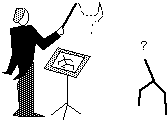
Lying at the conceptual center of this thesis is the gesture tool, which was conceived for the purpose of enhancing the interactive level of genetic algorithms for character animation. The idea was to design a tool which allows an interactive motion from the user to be brought under the grasp of the genetic algorithm, which uses that motion in a specialized fitness function. Although it is an experimental component of this thesis, tests have shown success.Here the notions of design and evolution are brought together in an experimental marriage. The design part can be described as the line-drawing that is gestured into the scene by the user. The evolution part comes into play as that gesture becomes a component in a specialized fitness function, which affects the evolution of the population. In developing this technique, two kinds of algorithms were implemented which interpret features of the gesture and relate them to some features of the characters as they move. The first algorithm compares the absolute position of a 2D character's moving head to the absolute position of a traveling point on the gesture. I found that this algorithm imposed too harsh a constraint on the evaluation. The second algorithm compares the direction and speed of the character's head motion to the direction and speed of a moving point on the gesture. This algorithm was found to be more flexible in that it allowed comparisons at a distance. These two algorithms are described in more detail at the end of the following section.
NUTS AND BOLTS
