
(Disney Meets Darwin)
4: Nuts and Bolts
Behavior Objects
Twelve species of behavior objects have been implemented. I have experimented with many kinds so as to explore the uses of evolution in a number of graphical domains and to generalize my system for purposes of demonstration and research. Most of the behavior objects are graphical, and most are dynamic in the sense that they exhibit animated motion. Below they are each listed and briefly described, accompanied by four sample snapshots to show variety.
Color images representing Josef Albers' "Homage to the Square" series, with variable color components in the regions in the image

Fractal tree biomorphs similar to Dawkins' Blind Watchmaker biomorphs (Dawkins, 86), but incorporating more degrees of asymmetry

Random grammatically correct sentences in which grammatical variations and vocabulary can be changed (these are the only non-graphical behavior objects)

Biomorphs consisting of curves defined by multiple sine functions.

Blinkers - flashing, shifting rectangles (these are meant to be candidates for effective attention-grabbers in a graphical interface)

Bouncing balls with simple physics constraints determining their motions, and some autonomy (they can jump in a variety of ways)

Animal Microworlds consisting of Logo-like turtles, bits of food, and predatorsÑbehaviors in the population of turtles can evolve for better eating and to avoid being eaten.

Swarming/schooling/flocking bits which exhibit collective behavior - variations in number and interactive forces create many varieties in the overall dynamic form

2D articulated stick figures with a fixed topology and variations in rhythms of multiple joint angle motions

2D articulated stick figures with variable morphology as well as motions

3D articulated stick figures with variable morphology and motions

3D articulated stick figures like above except the variations in morphology are constrained to a more realistic segmented animal-like scheme
As indicated by this list, a variety of domains have been explored within this system. What do they all have in common?
* They have behavior (their states can change over time). There are two distinct ways in which their states can change:
   a) Most of them are animated: they are continually changing their
      states in the sense that they exhibit  autonomous motion.
      For instance, the bouncing balls are always bouncing.

   b) The nature of this motion can also change (the attributes
      which define the kinds of motion).  These kinds of changes are
      the results of genetic operations.For instance, the degree of
      upward jump in a bouncing ball can change the nature of its
      motion. Non-motion attributes can change as well, such as the
      colors in the "Homage to the Square" species.
* Each behavior object has an associated genotype (the behavior object itself is the phenotype).
* They occur in multiples (as a species consisting of a population of individual behavior objects). Another way of thinking about them is that they are variations on a theme.
* Individual genes of the genotype can be manipulated in real time resulting in visual transformations of individual attributes, as indicated in figure 7.
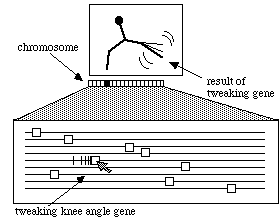
Figure 7 The user can "open up the hood" to see the contents of a chromosome. As the user tweaks an individual gene, the affects of changing this gene can be seen in real time in the phenotype.
THE ARTICULATED FIGURES
