
The Articulated Figures
The species of behavior objects which I have concentrated on in this thesis are the articulated stick figures. An earlier species which is not represented in this system is seen as a predecessor to the current phylum. It is called "Walker", and the anatomy consists simply of two 3D sticks (legs) joined together to form a hairpin shape (Figure 8). A Walker can autonomously change the angles at which the legs are joined together in a variety of ways. The changes of the angles in each of two angular coordinates in both of the legs are determined by sine functions whose amplitudes, phases, and frequencies can vary from one individual Walker to another (these parameters remain constant during the lifetime of the individual). The parameters are represented as genes and a GA is used to optimize these genes for walking behaviors (Ventrella, 92).
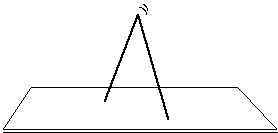
Figure 8 Walker
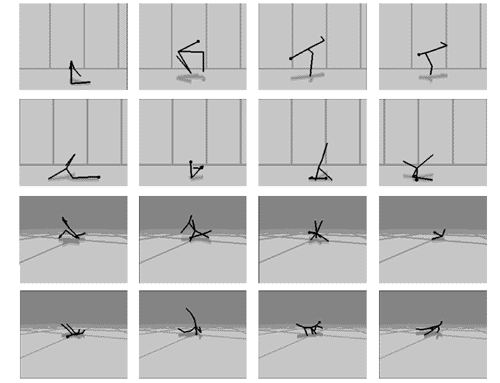
For this thesis, four new species of articulated figures have been designed. Each species that I have developed is more complex then the previous one. In a very real sense to me, they evolved from one to the other as I progressively extended my design of the basic phenotype. The latest species, which I call the "Vertebrates", constitutes the most complex phenotype design in the Character Evolution Tool. Figure 9 shows four variations each of the four example individuals of each species of articulated figures.
MORPHOLOGY
